
A Petrocontracts International White Paper | 2025
Executive Summary
In an industry increasingly defined by complexity, volatility, and contractual risk, the way organisations manage their contracts and claims has become a decisive factor in project success. While large multinational consultancies have historically dominated this space, a discernible shift is underway. Boutique contract and claims management consultancies, viz. smaller, specialised, and founder-led are gaining preference among discerning clients who value responsiveness, technical depth, and genuine partnership.
This paper, authored from the perspective of Petrocontracts International, examines the comparative effectiveness of boutique consultancies versus large firms in contract and claims management. Drawing from industry studies, case experience, and market analysis, it finds that boutique firms consistently deliver greater alignment, agility, and precision, particularly in high-stakes EPC, infrastructure, and energy projects.
However, large firms retain undeniable advantages in scale, global reach, and risk capacity. The paper therefore advocates not for competition, but for strategic complementarity where value is measured not by organisational size but by the quality and impact of expertise delivered.
1. Introduction
Contract and claims management sits at the intersection of law, engineering, and commercial strategy. In sectors such as construction, oil and gas, and infrastructure, the ability to effectively interpret, administer, and defend contractual rights determines project profitability and corporate resilience.
Historically, large consultancies with global offices and thousands of employees dominated this space. Their broad service portfolios and brand recognition gave comfort to major clients seeking stability.
Yet, in the past decade, a quiet but powerful evolution has emerged: boutique consultancies smaller, owner-led specialists focused on contract and claims are increasingly winning assignments once monopolised by industry giants.
The reasons are not accidental. They lie in specialisation, agility, and authenticity traits that are often difficult for larger organisations to replicate within their layered hierarchies.
2. Boutique vs. Large Consultancies – The Strategic Landscape
At their core, both models serve the same objective: to manage contracts effectively and resolve claims efficiently. Yet the structural DNA of boutique firms versus large multinationals leads to markedly different delivery experiences.
Table 1. Core Differentiators – Boutique vs. Large Consultancies
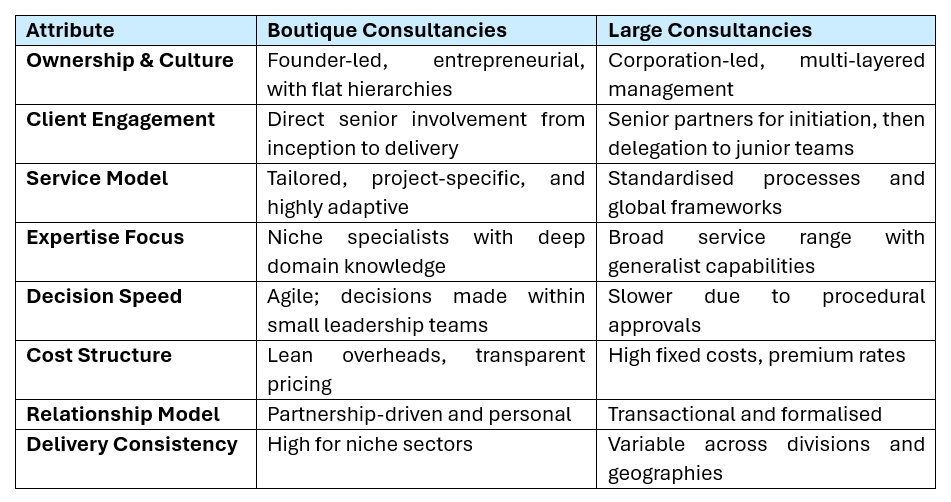
Boutique firms are typically led by professionals with decades of project and contractual experience—often former client-side managers, engineers, or lawyers. This experience translates into:
- Accurate risk identification and entitlement recognition
- Efficient claim preparation and defensible positions
- Strategies aligned with real-world project pressures
Large firms, while capable, often deploy generalist teams balancing multiple client portfolios. The learning curve can therefore be longer, and recommendations more template-driven.
3.2 Agility and Responsiveness
In dispute resolution and contract administration, timing is critical. Boutique consultancies operate with structural agility, enabling:
- Rapid mobilisation in urgent claims or variation scenarios
- Dynamic adjustment to client priorities
- Minimal bureaucratic friction
By contrast, large organisations’ structured delivery models—though methodical—can slow responsiveness where immediate action is required.
3.3 Senior-Level Engagement
Clients engaging boutiques often deal directly with senior partners and subject-matter experts throughout the assignment. This consistency:
- Builds trust and accountability
- Enhances the continuity of advice
- Reduces rework and communication loss
Large firms may introduce senior figures initially for commercial assurance, but delivery frequently transitions to mid-level associate’s post-engagement.
3.4 Value and Cost Efficiency
With lean overheads, boutique firms provide greater value per consultancy hour. Clients typically benefit from:
- Transparent, deliverable-based pricing
- Reduced billing for non-productive overhead
- Tangible cost savings without quality compromise
Large firms’ premium rates are justified in contexts requiring broad geographic coverage or multi-disciplinary integration but often exceed budget thresholds for mid-sized contractors.
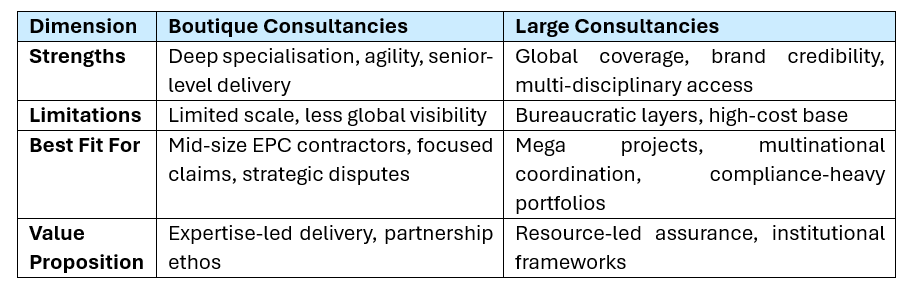
3.5 Advantages & Limitations: Boutique vs Large Consultancies
Table 2. Advantages & Limitations: Boutique vs Large Consultancies
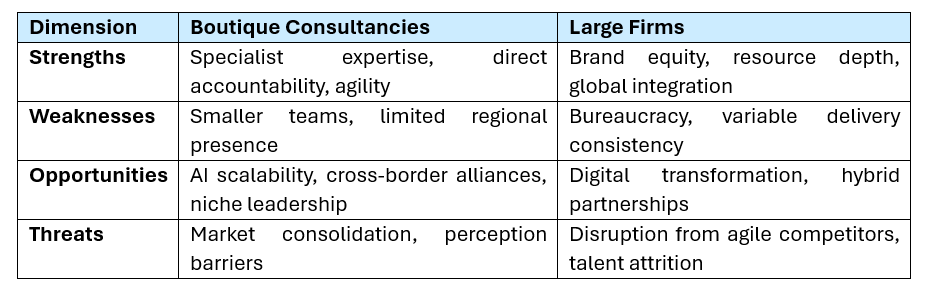
3.6 SWOT Matrix
Table3 – SWOT Matrix
4. Industry Perception and Market Shifts
Industry sentiment has evolved. According to surveys by RICS and Construction News (2023–2024), over 60% of mid-tier EPC and infrastructure clients reported higher satisfaction with boutique consultancies in claims-related engagements, citing agility and personal accountability as key differentiators.
Concept: Evolving Client Preferences (2015–2025)
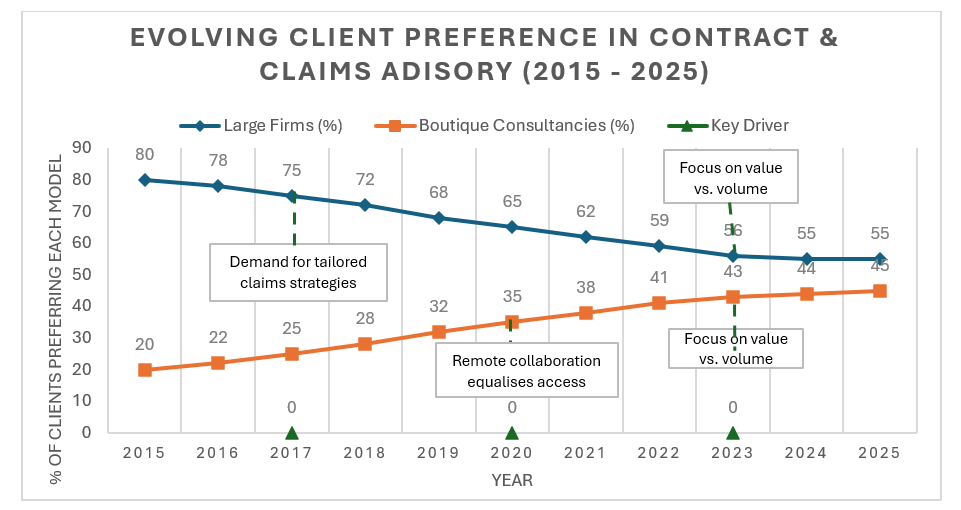
This data driven trend indicates a maturing understanding among clients: “bigger” no longer automatically means “better.”
Note: The percentage data (80%→55% and 20%→45%) shown in the chart is for illustrative and conceptual basis and is designed to visually demonstrate the industry trend
5. Challenges and Risk Perceptions
While boutique firms demonstrate clear advantages, certain client concerns persist.
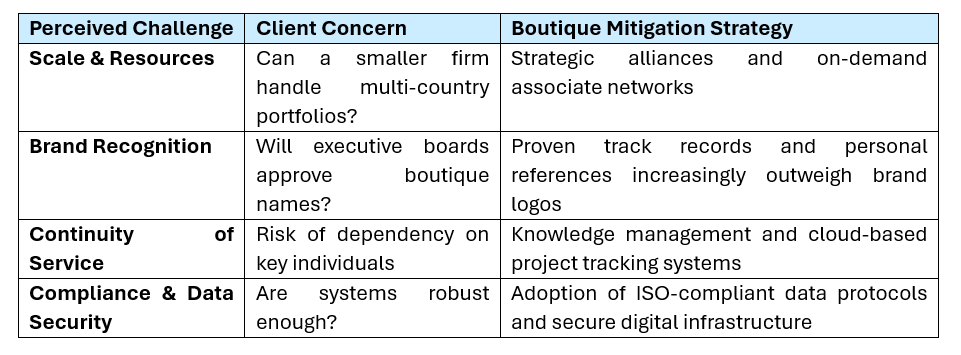
These challenges are not structural weaknesses, but growth hurdles increasingly addressed through collaboration, technology, and professional accreditation.
6. Case Illustrations
Case A – Boutique Excellence
A mid-tier infrastructure contractor engaged a boutique consultancy to recover delayed payment claims worth £25 million. Leveraging direct senior involvement, precise entitlement analysis, and focused negotiation, the team achieved recovery within six months after a larger firm’s 14-month engagement had produced limited traction.
Case B – Large Firm Coordination Strength
A multinational EPC contractor with operations in five regions retained a large consultancy to manage simultaneous disputes across jurisdictions. The firm’s global coordination, document standardisation, and legal network proved critical for consistent outcomes.
Insight: Effectiveness depends on scope. Boutiques excel in depth; large firms excel in reach.
7. Industry Insight: The Future of Consultancy Models
The next decade will likely see a hybrid ecosystem rather than clear market division. Three key forces are shaping this evolution:
- AI and Automation – Boutique firms are leveraging digital claim engines and contract analytics tools, narrowing the resource gap with large competitors.
- Collaborative Delivery Models – Partnerships between niche experts and global consultancies are increasingly common in mega-projects.
- Client Sophistication – Procurement teams are adopting value based evaluation models, assessing consultants on capability fit, not just firm size.
The consulting landscape is therefore transitioning from scale-based competition to competence-based collaboration.
8. Conclusion
Contract and claims management success is determined not by brand magnitude, but by the quality of expertise, responsiveness, and client alignment delivered. Boutique consultancies, such as Petrocontracts International, exemplify this through:
- Focused specialisation
- Direct senior engagement
- Transparent and efficient delivery
However, large firms will remain vital for global, multi-disciplinary projects requiring compliance infrastructure and financial depth.
The industry’s most progressive clients recognise that both models have merit. The optimal choice depends on project complexity, jurisdictional spread, and the desired relationship style. As projects grow in complexity and digitalisation blurs boundaries, the future belongs not to the largest, but to the most effective.